AI drafts the data. People approve it.
- Source-linked value proposals
- Accept, edit or reject per field
- Audit trail for every decision

Built for regulated data
- Role-based permissions for reviewers
- Clear distinction between proposed and approved data
- Exportable review history for inspections
- One audit trail for proposals, decisions and approved values
Less transcription, the same accountability
Read the source you already have
Lab reports, discharge letters, scanned CRFs and EHR data go in as they are. The AI maps what it finds to the eCRF fields you have already built, so there is no separate form to maintain.
- Typed and scanned documents
- EHR data over FHIR R4 and HL7 v2
- Mapped to your existing eCRF fields
- No reformatting of source before upload
See exactly where every value came from
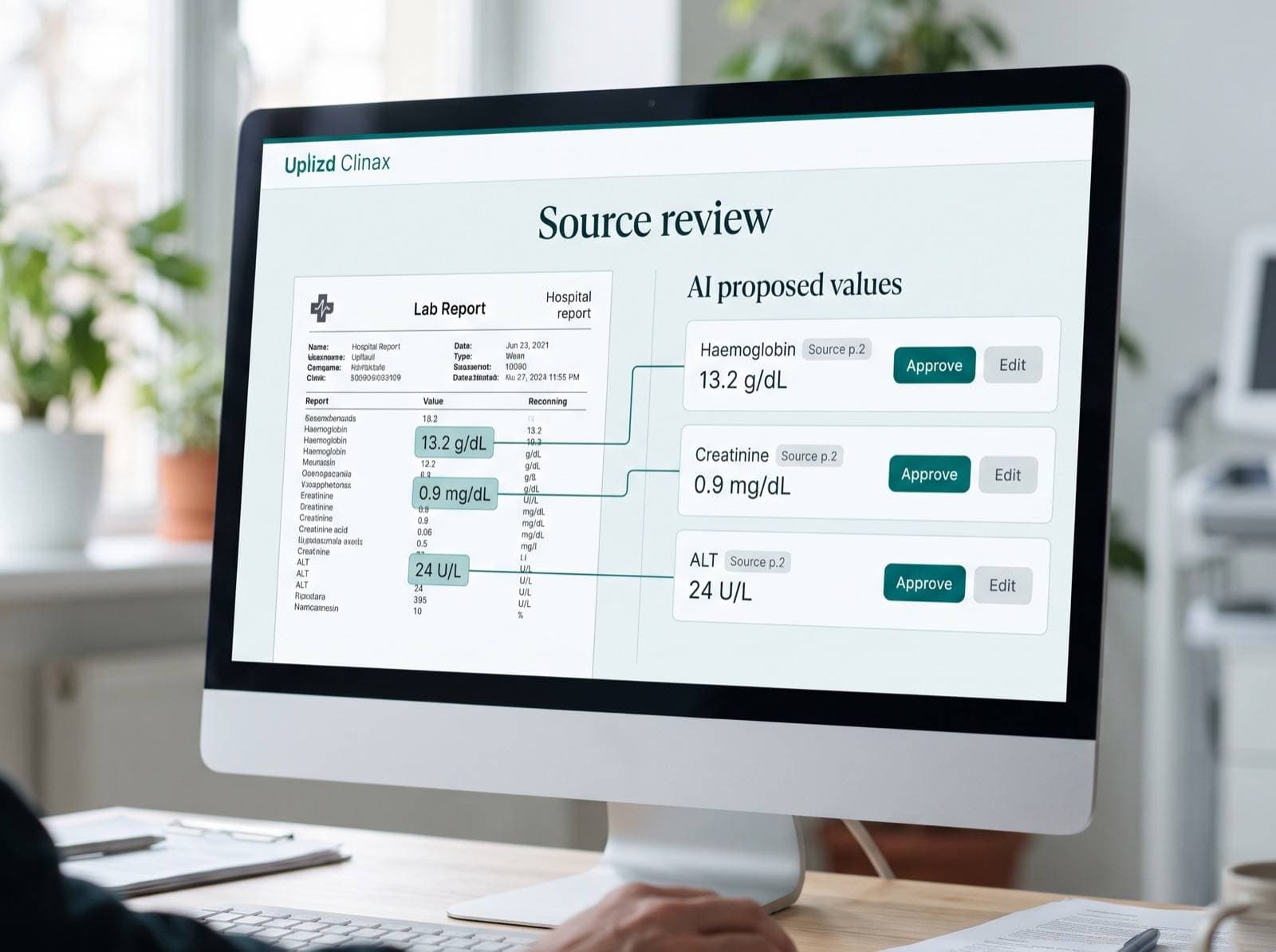
Each proposed value points to the passage it was taken from. Reviewers check the source and the value side by side, instead of hunting through pages to find it.
- Every value linked to the exact source passage
- Source highlighted beside the proposed value
- Proposed values clearly marked apart from approved data
- Review field by field through the form
Keep a qualified person in charge of every value
A reviewer accepts, edits or rejects each proposal. Only approved values reach the study record, and once they do, they go through the same edit checks, queries and verification as any other data.
- Accept, edit or reject per field
- Only approved values reach the study record
- Reviewer roles set through role-based access
- Approved values run through the usual edit checks and queries
Show inspectors the whole story
Every proposal and every decision is kept in the audit trail. For any value in the record, you can show where it came from, what the AI proposed and who approved it, when.
- Proposal and source passage recorded per field
- Reviewer, time and any edit captured
- Same audit trail as manually entered data
- Exportable review history for inspections
Use AI on your terms
Uplizd Clinax AI is model-agnostic, so you are not tied to a single model provider. It runs inside the same platform as your study data, under the same access controls and hosting choices.
- Model-agnostic by design
- Same role-based access and single sign-on as the rest of the platform
- Managed cloud, private cloud or on-premises hosting
- Data use defined in your agreement with Uplizd
How AI extraction works
- 1Sites
Source in
Upload documents or connect EHR data to the subject.
- 2Uplizd Clinax AI
AI proposes
Values are mapped to eCRF fields, each with its source passage linked.
- 3Qualified reviewer
Human approves
A reviewer accepts, edits or rejects every value before it is committed.
- 4Data management
Clean and verify
Approved values go through the same checks, queries and review as all study data.
AI extraction at a glance
- Sources
- Typed and scanned documents such as lab reports and clinic letters
- EHR data
- FHIR R4 and HL7 v2 connections, and structured exports
- Output
- Proposed values for existing eCRF fields, each linked to its source
- Review
- Accept, edit or reject per field by a qualified reviewer
- Audit trail
- Every proposal, decision, reviewer and time recorded
- Models
- Model-agnostic
- Access
- Role-based permissions for reviewers; single sign-on
- Hosting
- Managed cloud, your private cloud, or on-premises
Built for AI in regulated research
EMA (2024)
Reflection paper on AI in the medicinal product lifecycle
Sets out a risk-based approach to AI across the lifecycle, including clinical trials, with human oversight and data integrity at its centre.
FDA (2025 draft)
US FDA — AI to support regulatory decision-making
Draft guidance proposing a risk-based framework for establishing whether an AI model is credible for its intended use.
ALCOA+
Data integrity principles
Data that is attributable, legible, contemporaneous, original and accurate — and complete, consistent, enduring and available.
21 CFR Part 11
US FDA — electronic records and signatures
Every create, change and delete is recorded with user, time and reason, and electronic signatures are bound to the person who signed.
Frequently asked questions
Does the AI write directly into the study database?
No. AI produces proposals only. A qualified reviewer must approve each value before it is committed.
Which documents can it read?
Typed and scanned documents such as lab reports and clinic letters, plus structured EHR data. Quality of extraction depends on legibility of the source.
What happens if the AI proposes the wrong value?
The reviewer edits or rejects it. The original proposal, the correction and the reviewer's name are all kept in the audit trail.
Which AI model does it use?
Uplizd Clinax AI is model-agnostic, so it is not tied to one provider. Talk to our team about the options that fit your organisation's policies.
Does it replace source data verification?
No. Approved values enter the same review, query and verification workflows as manually entered data, following your monitoring plan.
Is participant data used to train models?
How study data may be processed is defined in your agreement with Uplizd. Talk to our team for the details that apply to your study.
Works together with
EDC
Electronic Data Capture
Build eCRFs in hours, capture site, lab and device data in one validated system, and reach database lock with fewer queries.
Learn moreeCOA / ePRO
Electronic Clinical Outcome Assessments
Replace paper diaries with questionnaires participants complete on any device, with reminders and compliance tracking built in.
Learn moreeConsent
Electronic Informed Consent
Recruit, screen and consent participants remotely, with comprehension checks and a complete audit trail for every signature.
Learn moreCDMS
Clinical Data Management
Queries, medical coding, source data verification and lock workflows that keep data managers in control of every study.
Learn more