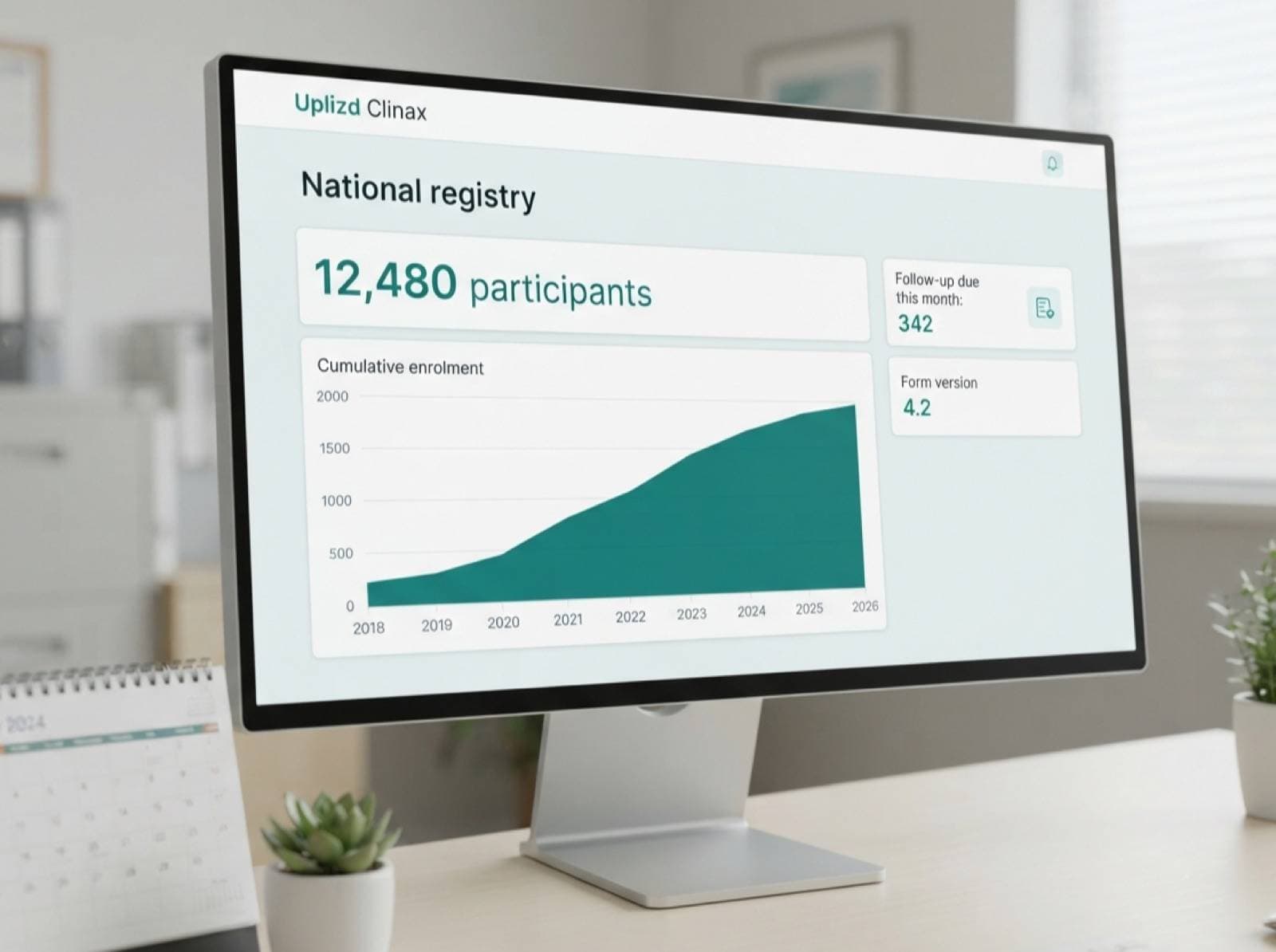
Registries that keep running for years
- Scales to large cohorts
- Flexible visit schedules
- Patient-reported outcomes
Why registries are hard to keep alive
- 01
Site engagement fades
Registry data entry rarely comes with the funding or urgency of a trial. When forms are long or repetitive, sites fall behind and follow-up quietly stops.
- 02
Questions change over time
New treatments, new outcome measures and new research questions arrive years after the first participant was enrolled. Changing the forms without breaking the historical data is where many registries stall.
- 03
Participants drift away
People move, change hospitals or are discharged from follow-up. Without a way to hear from them directly, outcomes between clinic visits are simply lost.
- 04
Data sits apart from routine care
Much of what a registry needs is already in the hospital record. Typing it in again costs site time and introduces transcription errors.
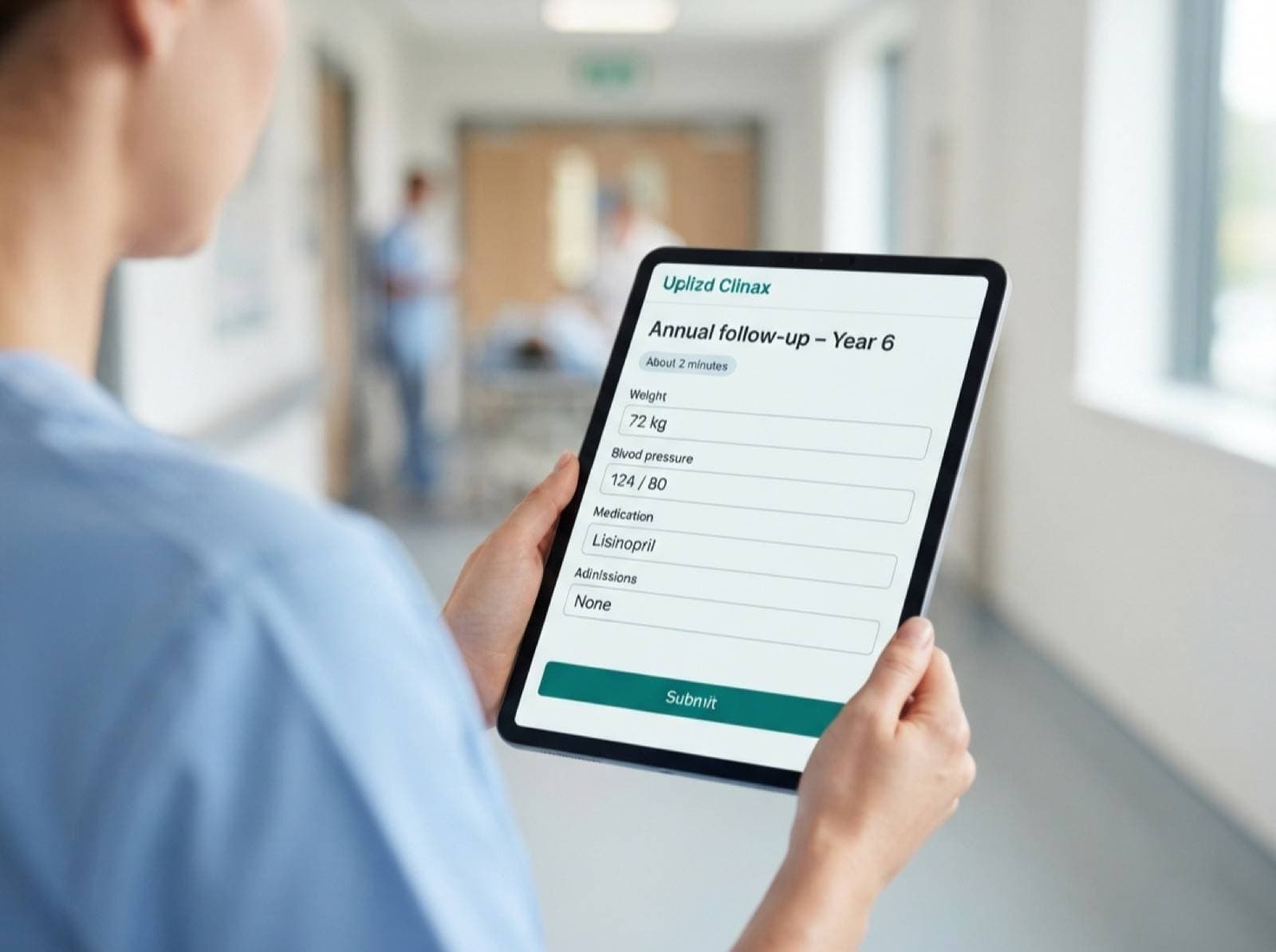
Low burden for sites, years of data
- Short, focused follow-up forms
- Participants report between visits
- Versioned forms as the registry evolves
- New sites added without rebuilding the study
Designed for the long haul
Open-ended enrolment
Keep the registry open indefinitely and add sites, countries and participants over time without rebuilding the study.
Flexible schedules
Periodic follow-up and event-driven forms — a relapse, a surgery, a pregnancy — side by side in the same registry.
Participant-reported outcomes
Participants answer questionnaires on their own phone or a provided device, offline if needed, with reminders between visits.
Retrospective chart review
AI proposes values from clinic letters and medical records, each linked to its source passage. A qualified reviewer approves every one.
A registry, year after year
- 1Registry team
Define once
Set up core data, outcome definitions and follow-up schedules from shared form libraries.
- 2Site
Enrol and consent
Register participants in clinic or remotely, with eConsent and identity checks where needed.
- 3Participant
Follow up
Answer questionnaires between visits, while sites record clinical events as they happen.
- 4Registry team
Analyse and evolve
Export pseudonymised data for analysis at any time, and release new form versions as questions change.
Grounded in registry guidance
EMA registry guideline
Guideline on registry-based studies (2021)
Methods, data quality and governance for studies that use patient registries to support regulatory decisions in the EU.
AHRQ user's guide
Registries for Evaluating Patient Outcomes
The US reference on planning, running and evaluating patient registries, from design and data elements to quality assurance.
ALCOA+
Data integrity principles
Data that is attributable, legible, contemporaneous, original and accurate — and complete, consistent, enduring and available.
GDPR · HIPAA
Personal and health data protection
Role-based access to identifiable data, encryption in transit and at rest, and hosting options that respect data-residency rules.
A registry platform built to last
Changing forms
Spreadsheets and survey toolsNew columns added by hand, with older records left inconsistent.
Uplizd ClinaxVersioned forms, with every record kept against the version it was collected on.
Adding sites
Spreadsheets and survey toolsCopies of the database sent out and merged back in.
Uplizd ClinaxNew sites added to the same registry, with their own users and permissions.
Participant outcomes
Spreadsheets and survey toolsPaper questionnaires at clinic visits only.
Uplizd ClinaxQuestionnaires on the participant's phone between visits, with reminders.
Traceability
Spreadsheets and survey toolsLittle record of who changed what, or why.
Uplizd ClinaxOne audit trail for every entry, change and review.
Frequently asked questions
Can we change forms after years of data collection?
Yes. Forms are versioned, so you can add or change questions while every historical record stays linked to the version it was collected on.
Can multiple organisations contribute?
Yes. Each organisation's sites have their own users and role-based permissions, so people see only the identifiable data they are allowed to see.
Can we link registry data with hospital records?
Yes. Uplizd Clinax connects to EHRs over FHIR R4 and HL7 v2, offers a REST API and imports lab and device files. Talk to us about the systems your sites use.
Is there an end date?
No. A registry can stay open indefinitely, with sites and participants added over time.
Can we run studies on top of the registry?
Yes. Studies can share form libraries and outcome definitions with the registry, so data collected in each stays comparable.
How do researchers get the data?
Authorised users export data whenever they need it, including pseudonymised exports for analysis outside the platform.
Modules behind it
EDC
Electronic Data Capture
Build eCRFs in hours, capture site, lab and device data in one validated system, and reach database lock with fewer queries.
Learn moreeCOA / ePRO
Electronic Clinical Outcome Assessments
Replace paper diaries with questionnaires participants complete on any device, with reminders and compliance tracking built in.
Learn moreeConsent
Electronic Informed Consent
Recruit, screen and consent participants remotely, with comprehension checks and a complete audit trail for every signature.
Learn moreCDMS
Clinical Data Management
Queries, medical coding, source data verification and lock workflows that keep data managers in control of every study.
Learn moreAI Data Extraction
Source-to-eCRF with human review
AI reads source documents and EHR exports and proposes structured eCRF values. A reviewer approves each one before it is committed.
Learn more