Turn routine care into regulatory-grade evidence
- AI-assisted chart abstraction
- Human review of every value
- Structured, analysis-ready data
Why real-world data is hard to trust
- 01
The answers are in free text
Diagnoses, dates of progression and reasons for stopping treatment often live in clinic letters rather than coded fields. Someone has to read each record and pull them out.
- 02
Manual abstraction is slow and inconsistent
Abstractors working from long records make different judgement calls and occasional typing errors. Checking their work means reading the records again.
- 03
Provenance gets lost
Once a value is in a spreadsheet, nobody can say which document it came from or who decided on it. Reviewers and regulators ask exactly that question.
- 04
Sources don't line up
Retrospective chart review, EHR feeds and prospective follow-up often sit in separate tools with different definitions. Combining them for analysis becomes a project of its own.

Less abstraction effort, the same rigour
- Every value linked to its source passage
- A qualified reviewer approves each one
- Consistent data definitions across sites
- Exportable review history
From messy source to clean evidence
AI chart abstraction
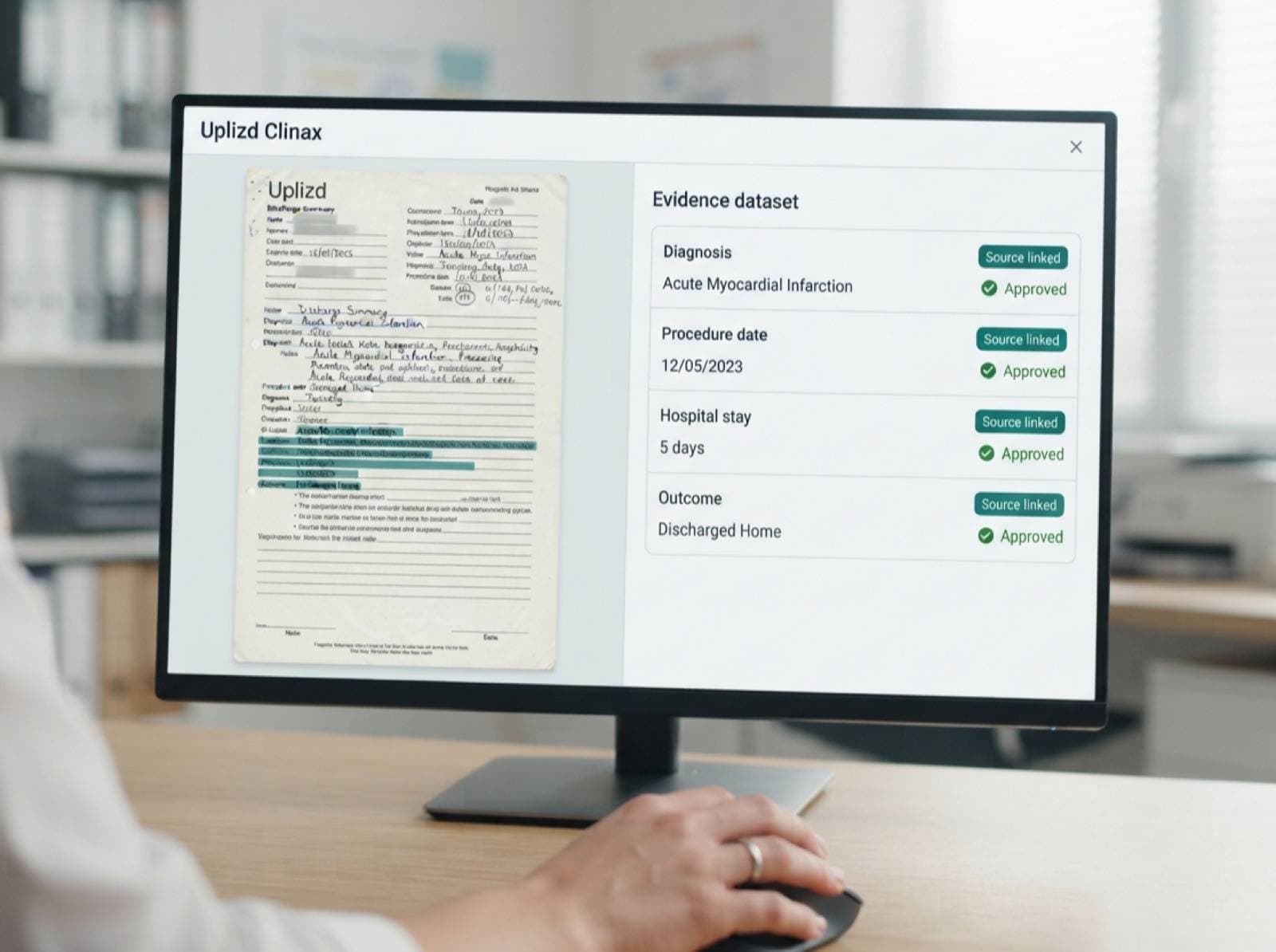
AI reads clinic letters, discharge summaries and reports, and proposes structured values for your eCRFs.
Source-linked review
Each proposed value opens next to the exact passage it came from. A qualified reviewer accepts, corrects or rejects it.
One data model
Abstracted, imported and prospectively collected data land in the same eCRFs, so a hybrid design needs no merge step.
Prospective follow-up
Add consent and patient-reported outcomes to fill gaps the record can't answer, such as quality of life.
Traceable and protected
Every value keeps its audit trail back to source and reviewer. Role-based access protects identifiable data, and exports can be pseudonymised.
From record to evidence
- 1Study team
Define the data
Set out variables, definitions and eCRFs in line with your protocol and analysis plan.
- 2Site
Bring in sources
Upload medical records or connect EHR feeds for the patients in scope.
- 3Reviewer
Review every value
Check each AI proposal against its source passage, then approve or correct it.
- 4Study team
Analyse
Export pseudonymised, analysis-ready data with the full review history alongside.
Built with regulators' expectations in mind
FDA RWE program
Framework (2018) and real-world data guidances
How FDA evaluates real-world evidence, and what it expects on the reliability, relevance and provenance of data from EHRs and other sources.
ENCePP methods guide
Methodological standards in pharmacoepidemiology
The European network's guide to designing and running observational studies, including data sources and data quality.
ICH E6(R3)
Good Clinical Practice
Risk-proportionate data review, with clear oversight of who entered, changed, reviewed and approved each value.
GDPR · HIPAA
Personal and health data protection
Role-based access to identifiable data, encryption in transit and at rest, and hosting options that respect data-residency rules.
Abstraction you can stand behind
First pass
Manual chart abstractionAbstractors read every page and type values into a spreadsheet or eCRF.
Uplizd ClinaxAI proposes values with their source passages; people review and decide.
Provenance
Manual chart abstractionThe link between a value and its source document is rarely kept.
Uplizd ClinaxEvery value is linked to the passage it came from.
Quality checks
Manual chart abstractionSecond abstraction of a sample, compared by hand.
Uplizd ClinaxA recorded review decision for every value, by a named reviewer.
Combining sources
Manual chart abstractionRetrospective, EHR and prospective data merged after the fact.
Uplizd ClinaxAll sources in one data model and one audit trail.
Frequently asked questions
Is AI-abstracted data accepted for regulatory use?
Acceptance depends on your study design, data sources and regulator. Every value is reviewed by a qualified person and traceable to its source, which is designed to support that case.
Does the AI enter data on its own?
No. The AI only proposes values. Nothing reaches the study record until a reviewer approves it.
Which sources can be processed?
Clinic letters, discharge summaries, lab reports, scanned forms and structured EHR data received over FHIR R4 or HL7 v2.
Can we combine retrospective and prospective data?
Yes. Both land in the same study record and data model, under one audit trail.
How is patient privacy protected?
Role-based access limits who sees identifiable data, exports can be pseudonymised, and hosting is available in managed cloud, private cloud or on-premises.
Can we check how well the AI is doing?
Yes. Every proposal and every reviewer decision is recorded, so you can see how often values were accepted or corrected.
Modules behind it
EDC
Electronic Data Capture
Build eCRFs in hours, capture site, lab and device data in one validated system, and reach database lock with fewer queries.
Learn moreeCOA / ePRO
Electronic Clinical Outcome Assessments
Replace paper diaries with questionnaires participants complete on any device, with reminders and compliance tracking built in.
Learn moreeConsent
Electronic Informed Consent
Recruit, screen and consent participants remotely, with comprehension checks and a complete audit trail for every signature.
Learn moreCDMS
Clinical Data Management
Queries, medical coding, source data verification and lock workflows that keep data managers in control of every study.
Learn moreAI Data Extraction
Source-to-eCRF with human review
AI reads source documents and EHR exports and proposes structured eCRF values. A reviewer approves each one before it is committed.
Learn more